George Gasgoigne at 450
International Symposium
Binghamton University, Binghamton, NY
March 19-20, 2027
Call for Papers
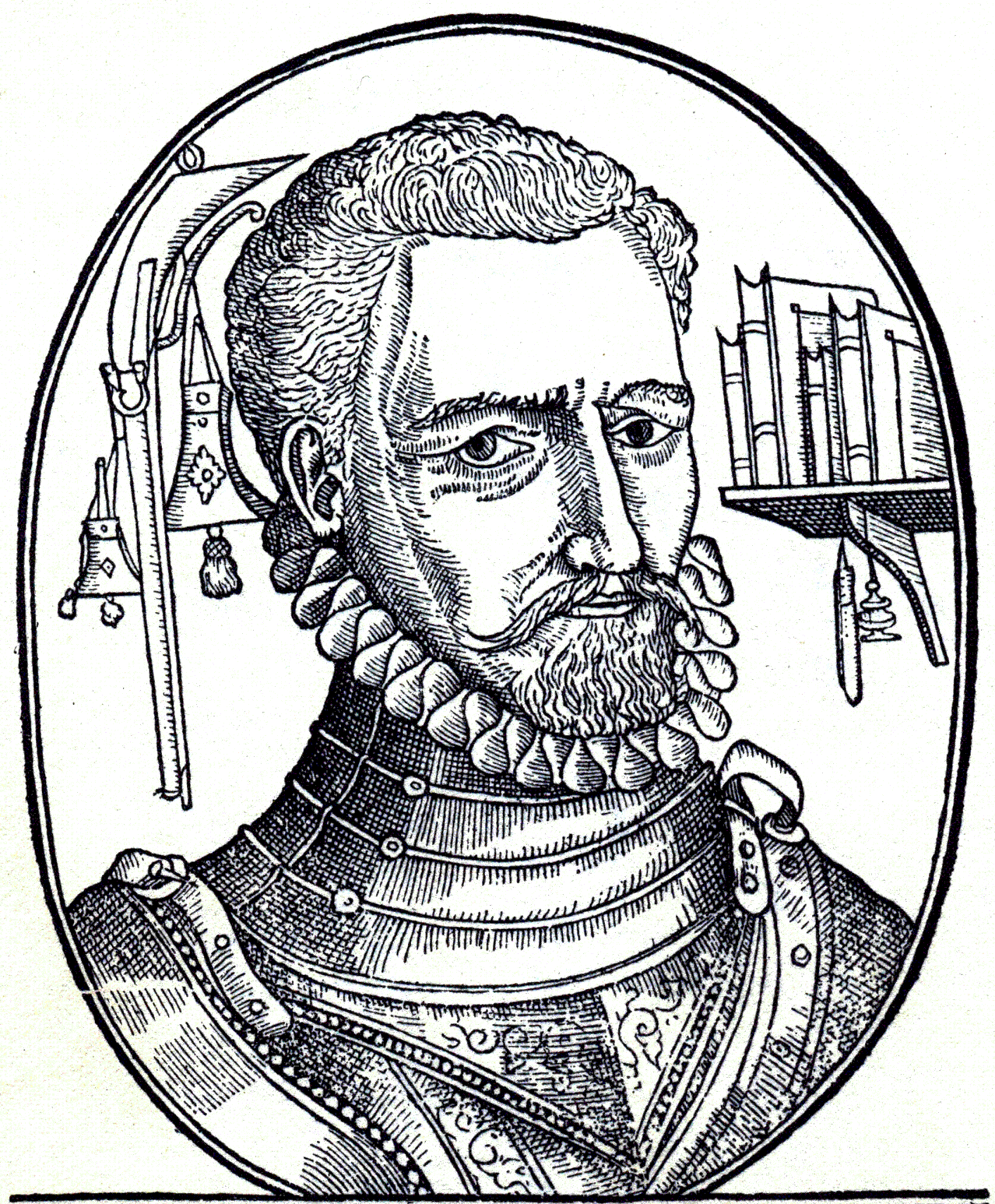
When George Gascoigne died in 1577, he had achieved a number of literary “firsts”: the first prose comedy in English (The Supposes), the first English adaptation of a Greek tragedy (Jocasta), one of the first English sonnet sequences, one of the first print collected works of a living author (A Hundreth Sundrie Flowres), the first treatise on English prosody (Certain Notes of Instruction), and what some called the first English novel (The Adventures of Master F.J.). Yet Gascoigne was nearly forgotten until 1869, when Hazlitt released his two-volume Complete Poems. For much of the twentieth century Gascoigne’s critical reception was mixed: by turns scion of C.S. Lewis’s “Drab Age” or progenitor of Lyly, Sidney, and Shakespeare. “George Gascoigne at 450” takes as its premise rising interest in Gascoigne in the twenty-first century. In recent years scholars have viewed Gascoigne’s varied corpus from the vantage points of classical reception and novel theory, the Inns of Court and the humanist grammar school, book history and queer studies. This one-day symposium will bring together scholars from around the world to assess Gascoigne’s legacy 450 years on.
By attending to a writer often described as premature, belated, transitional, or untimely, this symposium also welcomes a wider conversation about literary history, scholarly attention, and the temporalities through which Renaissance texts continue to matter. Neither securely canonical nor fully marginal, Gascoigne raises questions about the frameworks through which syllabi and scholarly publishing (among other venues) assign significance. What forms of writing—or modes of criticism—evade immediacy, influence, or present-day applicability? Other topics of interest might include literary experimentation and failure; the rhetoric of “firstness”; courtly performance and misperformance; textual circulation and revision; colonial and transnational contexts (esp. Gascoigne’s links to Ireland); ecological approaches (in e.g. “The Green Knight”); race and religion (in e.g. Masque of Montacutes); book history and material texts; form and formalisms.
Submission Requirements: Interested participants should submit an abstract of less than 250 words to the organizers, Bailey Sincox (bsincox@binghamton.edu) and Felicity Brown (felicity.brown@ell.ox.ac.uk). Please include a title and short bio as well as the author’s name and contact information. The deadline for abstract submission is October 1, 2026.